 AI-Ready Ads

Central Piedmont's billboards talk back with AI
lūquire's hidden-camera film for the Charlotte college ran on technology that arrived weeks before the shoot
Sponsored by

Central Piedmont Community College in Charlotte has its first campaign from lūquire, its new agency of record. 'Future You Will Thank You' puts people in front of interactive digital billboards where they talk, in real time, with AI-generated versions of their future selves.
Four production companies turned the project down, and the technology arrived just weeks before the September shoot, with one take per person. The two-minute film debuted on November 17.

Where AI sat: At the heart of the campaign is a two-minute hidden-camera film that captures people coming face-to-face with AI-generated versions of their future selves through interactive digital billboards. — Ads of the World
“Grounded in research we conducted together with Lucid, ‘Future You Will Thank You’ speaks to the uncertainty prospective students feel in today’s world and shows them a clear path forward.”
Bragg Swain, Associate Vice President of Marketing and Creative Services, Central Piedmont Community College
Today in Creative AI
Pika published a research preview of Pika Enact on November 18, designed to make generation feel like directing on set. Built on Pika H3 Flex, it streams video and sound in sub-second chunks.
A creator can reposition actors with a mouse, give them spoken notes, and move the camera while the scene plays. It is not a product yet: Pika says Enact is unavailable for consumer use.
Today’s Sponsor:
State of Product reveals what AI still hasn’t solved
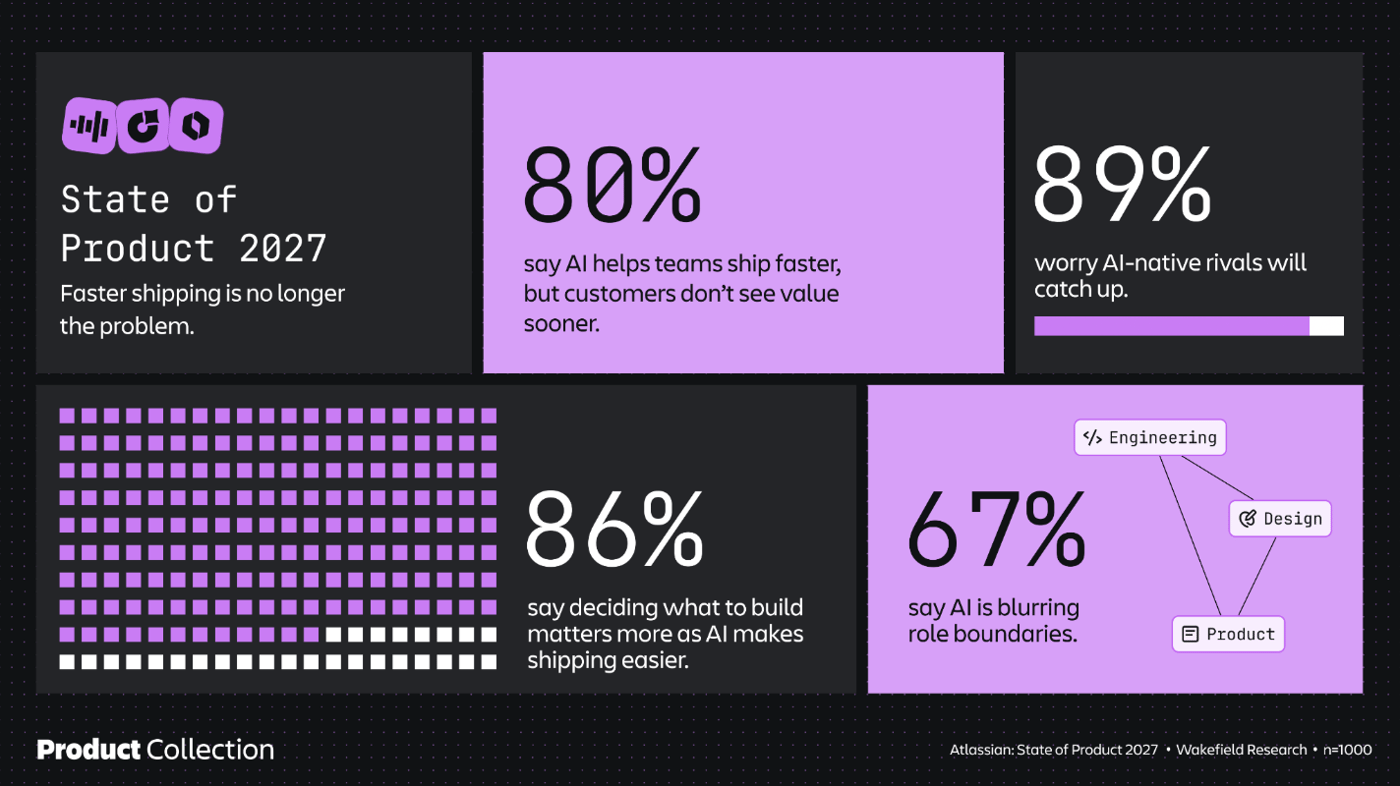
80% of product professionals say AI helps them ship faster, but customers aren’t seeing value any sooner. Atlassian’s State of Product 2027 explores the gains AI is delivering and the challenges that remain, from decision-making that hasn’t kept pace to gut instinct overriding customer evidence.
The Read
Both pieces move AI from rendering to responding. Central Piedmont's billboards had to hold a live conversation with a stranger on the first take, and Pika is building that reflex into a director's tools.
It is good advertising, because the product is the conversation: a prospective student hears, from their own older face, that the decision worked out. The risk is that a face that drifts is filmed too.
For brands: Brief the human truth first; Central Piedmont's research with Lucid came before the billboard.
For agencies: Budget for a pilot when the tool is weeks old, because four production companies passed on this job.
Tool Review → Wispr Flow
Wispr Flow turns speech into text in any app, in more than 100 languages, and learns your names and jargon. The free plan covers dictation and meeting notes; Pro costs $15 per user a month, or $12 billed annually, with unlimited dictation and a shared team dictionary.
A creative director can talk through notes on a cut and drop them straight into a Slack thread. The limit: it saves typing, not thinking, and free meeting history lasts 30 days.
Worth it if your team writes more notes than scripts. Skip it if feedback already happens in the room.
Make this
Show one character at two ages, recognizable in every shot, on one Krea Nodes canvas. The method comes from Krea's notes on its short films ROCKET and RECESS.
List every character, prop, and location the script needs.
Give each a Krea 2 Turbo image node: raw mode on, 8 steps, guidance 0, moodboard at 80.
Generate each character as a sheet: front, back, and a close-up of the face.
For the older version, describe the character in words rather than feeding in the child's image.
Plug the images into a Seedance 2.5 node and call them @Image1, @Image2 in plug-in order.
Copy this: Same girl as an adult: same bob haircut, same big eyes, one small mole on her cheek. Three views: front, back, close-up of the face.
What to expect: Each Seedance scene runs up to 30 seconds. Krea approved every sheet before generating video, which costs more, and gave each character one fixed facial detail to catch drift.